Motion deblurring framework
deblurring is solved?
Motion deblurring is spread over dozens of datasets, codebases and ways to score results. This framework puts it in one place, so the question above can be answered.
| What you get | Today | With the framework | Section |
|---|---|---|---|
| Clean, unified method code | every method in its own repository, training framework and custom layers | plain PyTorch with the authors' outputs, every method in the same layout (network, encoder, blocks) and called the same way; NAFNet-64 imports in 6 ms instead of 1.6 s | dbis |
| Compact test sets | ≈82 GB of archives on several hosts, each in its own layout | 6.9 GB for GoPro, REDS and RealBlur in one lossless format, only the frames that are scored, a CRC on every frame: on Hugging Face | Data |
| Same harness and requirements | own dependencies and versions for every method | 96 methods run from one harness on pinned environments | Methods |
| Unified benchmarking protocol | own crops, padding, metrics and hardware in every paper | 268 variants × 8 test sets × 10 metrics, latency on one A100 | Protocol |
| Our versions with small patches | released once and never updated, though simple fixes would help | faster and lighter, never more than 0.05 dB below the authors' PSNR: NAFNet-64 24 % faster, weights 4.1× smaller, BSSTNet 5.6× faster, weights 4.9× smaller, DSTNet+ L 5.2× faster, weights 3.5× smaller, Turtle 3.8× faster, weights 3.5× smaller | dbisf |
Data: the test sets in one format
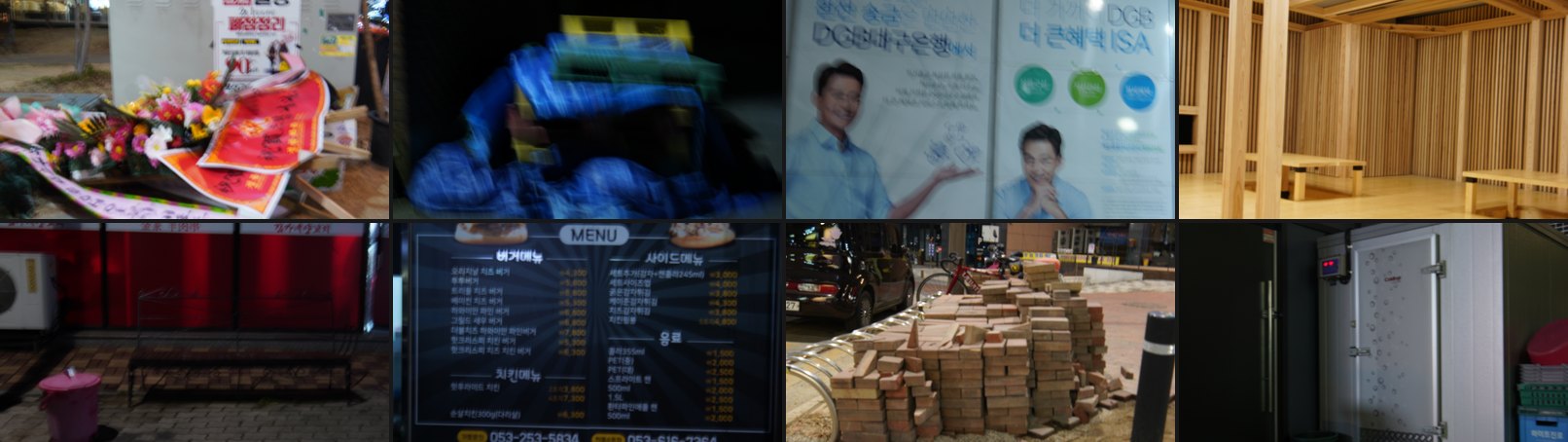
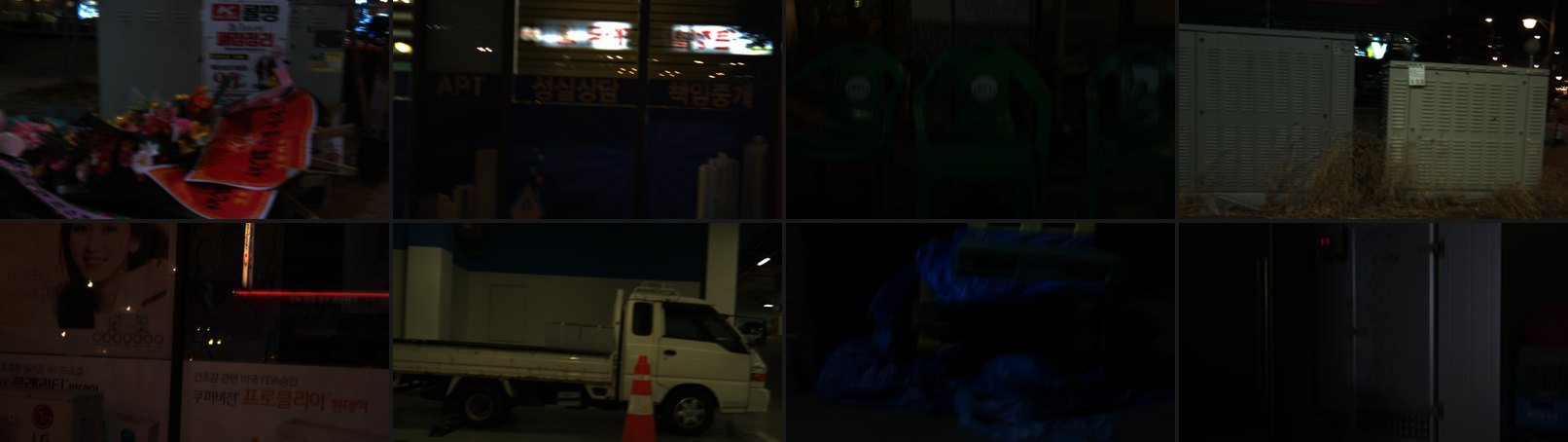
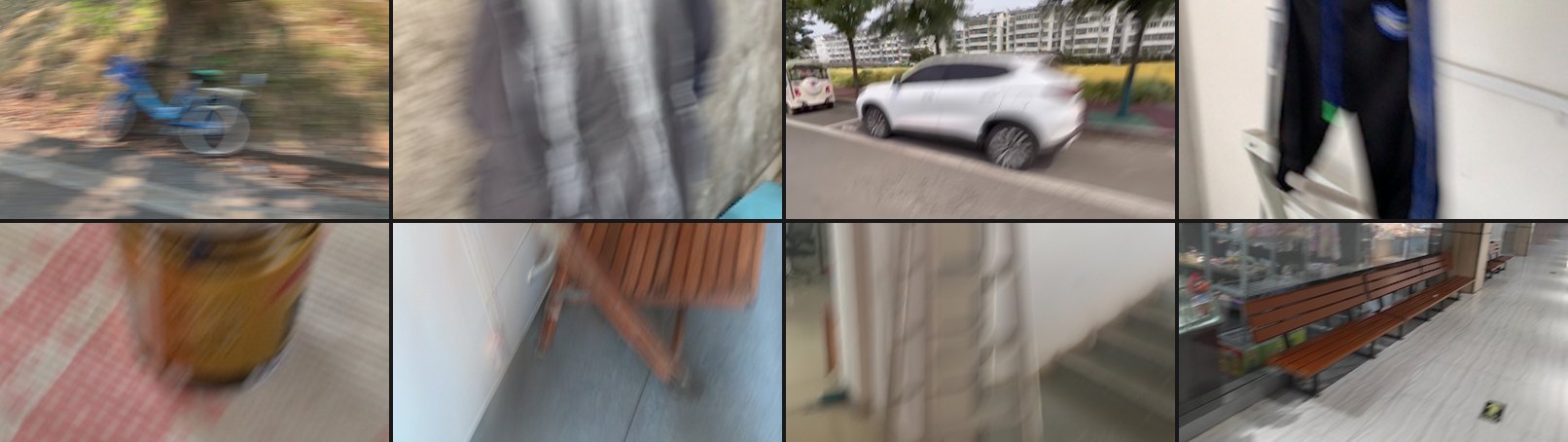
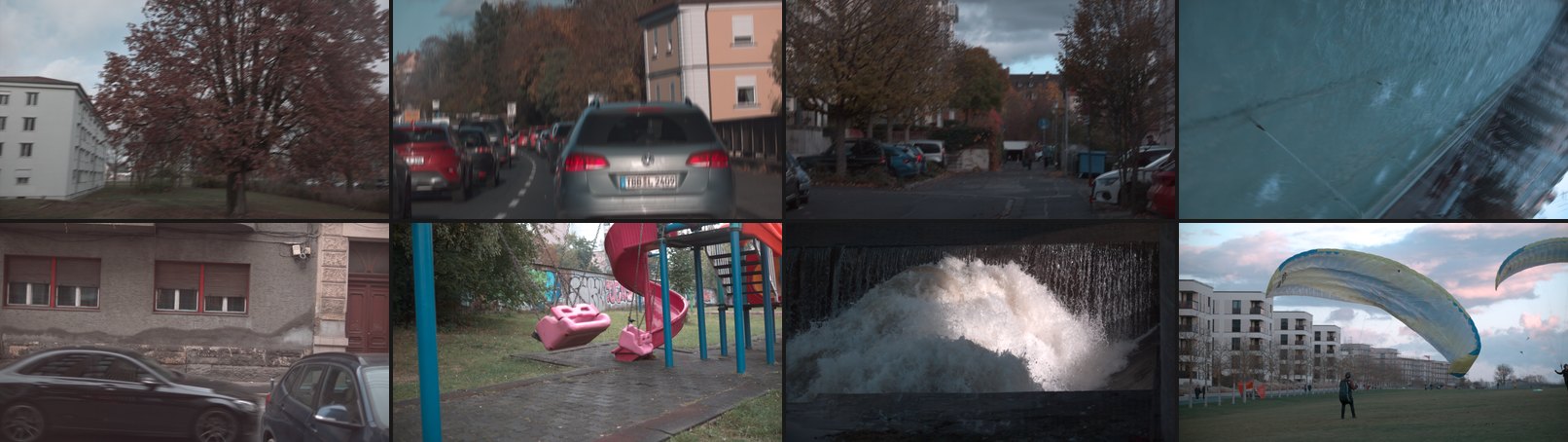
The frames every method is scored on. GoPro, REDS and RealBlur, released under CC BY 4.0, are on Hugging Face as lossless FFV1 with a CRC on every frame: 6.9 GB instead of 28 GiB of the authors' archives (python tools/testsets.py download). The other sets state no license for copies; their cards link to the authors' release.
Methods: one harness for all of them
Every method with released weights, image and video, runs through the same harness with the same inputs, and every released checkpoint is scored.
Protocol: one way to measure
| Set | Sequences | Frames | Resolution | Blurry input PSNR | Input |
|---|---|---|---|---|---|
| GoPro test | 11 | 1,111 | 1280×720 | 25.64 | blur |
| REDS val | 30 | 3,000 | 1280×720 | 26.27 | val_blur |
| BSD 2ms/16ms test | 20 | 3,000 | 640×480 | 26.63 | Blur/RGB |
| DVD test | 10 | 1,000 | 1280×720 | 27.29 | input |
| RealBlur-J test | 50 scenes | 980 | about 670×763 | – | blur |
| RealBlur-R test | 50 scenes | 980 | about 670×763 | – | blur |
| GS-Blur mini | 752 scenes | 1,000 | 480×270 to 1920×1080, both orientations | – | input_noise |
| MIORe, 300 of train | 300 images | 300 | 1920×1080 | – | blur |
- Every released checkpoint of a method runs on every test set: video methods on the four video sets, image methods also on RealBlur-J, RealBlur-R, GS-Blur and MIORe, which hold single images. Trained on picks the checkpoints shown: GoPro (the default), the training split of the current test set, any set, or one training set.
- GS-Blur: the 1,000 pairs of the authors' mini release, with the noisy blurred input (
input_noise), each image at its own size. MIORe: only its training part has public sharp frames, so the test set is 300 of the 7,860 public training pairs, evenly spaced over the sorted file list. Both are scored like the other sets, without alignment. The GoPro checkpoints of NAFNet diverge on part of these images (outputs far outside the valid range, a PSNR of 3 to 6 dB, the same in fp32 on the CPU). Those images stay in the scores. - On RealBlur, PSNR and SSIM follow the dataset's official evaluation: each output is aligned to the sharp image by an ECC homography and scored on the valid region (scikit-image 0.17.2, OpenCV 4.2, as the script requires). LPIPS and the other metrics use the unaligned output.
- PSNR and SSIM are computed per frame on 8-bit RGB outputs against the sharp frame and averaged over all frames of the set. LPIPS uses the AlexNet backbone.
- A score is final when at least 95 % of the frames of the set are scored. Runs below that are shown under unfinished runs.
- Each row is one variant of a method: the whole frame at once, tiles, test-time local converter (TLC), or the temporal scheme of a video method.
- Compute (GMAC) and latency are measured per output frame at 1280×720, batch 1, on one A100. A method that needs a window of frames to emit one frame is charged for the whole window.
- Frame characteristics come from the sharp frame and its blurry input: blur as the PSNR of the input and the share of gradient left after blur, texture, brightness, contrast, clipped highlights, input noise (Immerkaer) and colorfulness. Motion on the four video sets is the optical flow between consecutive sharp frames (MEMFOF). Every frame with its characteristics and every method's score on it is in
results/frames/bench.sqlite. - The perceptual and no-reference scores (MS-SSIM, LPIPS-VGG, DISTS, PaQ-2-PiQ, MUSIQ, CLIP-IQA+) are the defaults of pyiqa 0.1.16, computed in fp32 on the stored lossless outputs of each run. A row shows them once every frame of the run is scored.
- BASED-4 (higher is better) scores the restored frame against its own blurry input, with no sharp reference: four convolutional features and a linear head fitted to a subjective study of deblurring results (BASED, VCIP 2023). It is computed on the stored lossless outputs.
Analysis: the full picture
Pareto front
Leaderboard
Results as CSVTwo methods, frame by frame
Pick two methods. Every test frame of the set is one observation: how much better method A scores than method B on it, and what that frame is like (how strong its blur is, how fast it moves, how dark or textured it is).
One method across frames
Where a method does well and where it does not: its score on every frame of the set against a frame characteristic, and its rank among the GoPro-trained methods within each fifth of the frames along every characteristic.
Frames
A few frames of each set, picked at the extremes of the frame characteristics. Compare any two outputs with a sliding divider, side by side, or side by side with a magnified window, and switch to their error maps.
our versions of the methods
dbis gives the authors' outputs from plain PyTorch and a safetensors file, every method in the same layout with an encoder that loads on its own. dbisf is faster and lighter, and its mean PSNR is never more than 0.05 dB below the authors' code on any test set. What changed in each method: DBIS.md.
| Model | Weights | Load | Time per 720p frame | GoPro PSNR |
|---|---|---|---|---|
| NAFNet-64, GoPro weights | ||||
| authors' code | 272 MB | 3.06 s | 34.9 ms | 33.7103 |
| 271 MB | 0.70 s | 33.5 ms | 33.7103 | |
| 66 MB | 0.77 s | 26.6 ms | 33.7041 | |
| BSSTNet, GoPro weights | ||||
| authors' code | 209 MB | 3.50 s | 25.6 s | 35.9662 |
| 175 MB | 1.66 s | 30.6 s | 35.9662 | |
| 42 MB | 1.71 s | 4.6 s | 35.9425 | |
| DSTNet+ L, GoPro weights | ||||
| authors' code | 56 MB | 2.78 s | 3.0 s | 35.7078 |
| 56 MB | 0.54 s | 3.4 s | 35.7078 | |
| 16 MB | 0.60 s | 584.9 ms | 35.6999 | |
| Turtle, GoPro weights | ||||
| authors' code | 237 MB | 0.69 s | 760.9 ms | 34.5598 |
| 236 MB | 0.74 s | 723.9 ms | 34.5598 | |
| 68 MB | 0.83 s | 198.7 ms | 34.5316 | |
Load: a fresh process, from CUDA ready to the network with its weights on the GPU. Time: the benchmark's latency harness on one A100, 1280×720, batch 1, the three versions of a method on the same node. NAFNet-64: fp16 with torch.compile and CUDA graphs. BSSTNet: one window per output frame as in the leaderboard (48 frames for the authors' code and dbis, 24 for dbisf), each version in its fastest mode that runs (the authors' code fp16 with torch.compile, dbis fp16 eager, dbisf fp16 with its heavy blocks compiled). DSTNet+ L: a 27-frame window for every output frame as in the leaderboard; the authors' code and dbis in float32 (the authors' CuPy kernel has no float16), dbisf in float16 with its propagation blocks compiled. Turtle: one frame per step with the history carried, as the authors' tiled inference; each version in its fastest valid mode. PSNR: all 1,111 GoPro test frames. Every number: results/dbis/NAFNet-64.json, results/dbis/BSSTNet.json, results/dbis/DSTNetPlus-L.json, results/dbis/Turtle.json.
pip install "deblurring-is-solved[bsst] @ git+https://github.com/illaitar/deblurring-is-solved"   # the package, from GitHub

python -m dbis.run dbisf-Turtle blurry.mp4 sharp.mp4   # a video, a folder of frames or an image
python -m dbis.train dbisf-NAFNet-64 --data DIR        # training: the authors' recipe, the batch fitted to the GPU's memory

import dbis
net = dbis.load("dbisf-BSSTNet")       # every model the same way; the weight file comes from Hugging Face on first use
out = net.restore(frames)              # options: tile, tile_overlap, window, batch, precision, compile, out

# the files: https://huggingface.co/Illaitar/<model>, or made from the authors' checkpoints
python -m dbis.convert NAFNet-64 NAFNet-GoPro-width64.pth          # -> weights/dbis/
python -m dbis.convert BSSTNet BSST_gopro.pth raft-things.pth      # BSST and its RAFT
python -m dbis.convert DSTNetPlus-L DSTNetPlus_L_gopro.pth
Anatomy of the networks
Where each network keeps its parameters and where its compute goes, block by block, on one 1280×720 frame. Pick the networks to compare; tap a block or a scale for its numbers.
Scale: the resolution a block works at, relative to the frame the network takes in. Tap a scale to light up its blocks below.
A block is one unit of a network's design (NAFNet's NAF block, Concertormer's CSA block, Turtle's attention block, DSTNet+'s residual blocks, BSSTNet's alignment, sparse transformer and shift blocks); the narrow columns between blocks are the other layers (scale changes, first and last convolutions), and BSSTNet's RAFT, which it keeps fixed, is one cell.
Counted on our dbis code with PyTorch's FLOP counter on one 1280×720 frame (FLOPs = 2 × multiply-adds), the frame padded as each network pads it: python tools/anatomy.py. Video networks per frame: DSTNet+ and BSSTNet on an 8-frame clip (BSSTNet on real GoPro frames, since its sparse attention picks tokens by the blur), Turtle on its second frame, with its history. The dbisf versions have the same blocks.
Get started
git clone https://github.com/illaitar/deblurring-is-solved
pip install "deblurring-is-solved @ git+https://github.com/illaitar/deblurring-is-solved"
python -m dbis.run dbisf-NAFNet-64 blurry.png sharp.png
Every score: leaderboard.csv; per sequence and per frame: results/ in the repository.